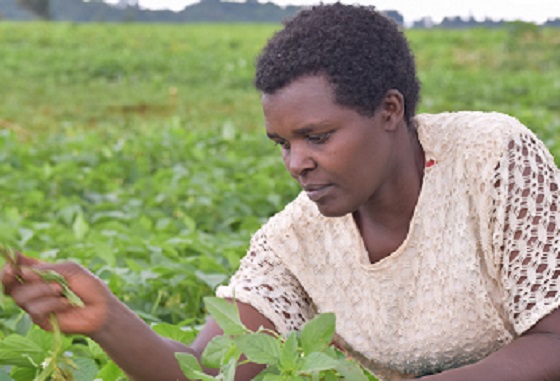
As she studied her calloused palms, Mary Moraa joked that it’s the price she pays to make a decent living.
For over a decade, the 37-year-old mother of five relied on maize farming for her income. Unstable market prices made it impossible to predict when the produce would fetch a good price and she struggled to get by, often selling all the maize in her barn to pay her children’s school fees and buy food for her household.
When Farm Africa, with funding from Medicor Foundation, introduced French beans, garden peas, snow peas and sugar snap farming to the Endebess region of Trans Nzoia County in Kenya, Mary’s business began to thrive. She joined the Salama Cluster of farmers and was taught about crop husbandry, good agricultural practices and how to market her produce so she can sell in bulk to buyers.
The Growing Futures project has been helping young farmers in western Kenya set up profitable enterprises by growing and selling vegetables that are in high demand in Kenya’s booming horticulture sector.
Between 2016 and 2019, farmers taking part in Growing Futures have recorded a 51% increase in overall household income. Their yields have also increased from 129 Metric Tonnes to 2,533 Metric Tonnes, surpassing Farm Africa’s initial target by 41%.
Before taking part in the project it was commonplace for Mary’s children to be sent home due to unpaid school fees, this changed with her second harvest in May 2018 when she gained a healthy profit from the 1,470 kilograms of crops she sold.
“My husband was planning to sell our only cow to raise money to send our two children back to high school. Fortunately, the crop produced bountifully, yielding 1,300 kilograms from the two kilograms of seeds I had planted. From the 55,000 Kenyan Shillings sales proceeds, we paid the school fees needed for the whole year.”
Growing Futures helps farmers groups identify and approach Kenyan and international buyers, and supports the development of contracts to ensure that the terms benefit the farmers. So far, 23 renewable contracts have been secured and farmers have worked with 38 additional buyers.
Mary has also benefitted from linkages to financiers where she is able to borrow loans to grow her enterprise. So far, 17 groups (out of 20) have been linked with finance providers.
Mary now hires up to four people during harvest and always ensures that her children help when they are not in school so that they can understand the farm operations.
“I have identified a one acre piece of land, which I plan to lease next year so that I can increase my production. Since I have started saving towards building a better house for my family, I will have to work extra hard.”
She adds that farming demands consistency and undivided commitment. She goes to the farm early in the morning and heads back home at twilight. Despite being demanding work, Mary won’t give up on her farm as her labour is evidently paying off.
CREDIT: https://www.farmafrica.org/us/latest/news/post/672-growing-incomes-for-kenyaas-young-vegetable-farmers