To boost food security, Kenyans have been urged to adopt innovations like drones.
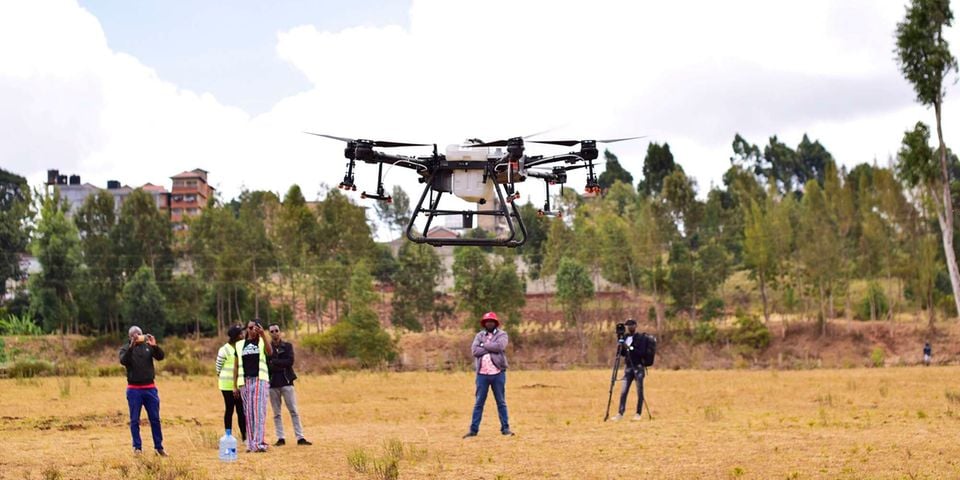
Using drones in agribusiness, mapping, survey and even spraying pesticides on crops enhances productivity and helps reduce operational costs.
Global Air Drone Academy (GADA), a US-based company, employs the technology to scale up efficiency in agriculture.
Kenyan farmers have relied on knapsack sprayers to apply chemicals to their crops and human surveyors to map farms as countries like Ghana, Rwanda and South Africa make use drones in these activities.
During the Kenyan Drone Business Competition (KDBC) that saw 10 finalists interact with international industry experts at Drone Space Training Airfield, in Sigona, GADA chief executive and founder Enoh Umoh, said young people are being equipped with tangible agri-technology drone skills.
“This year’s edition is centred around using drones in forestry, precision agriculture, AI, insurance claim assessments, livestock management and delivery of food,” he said.
“The technology reduces the time for fertiliser application. It ensures that the application coincides with good weather. The technology also enhances yields while reducing costs as well as adverse damage to the environment.”
KDBC aims at fostering innovation and developing entrepreneurial abilities of young Kenyans. It also provides a platform for accessing STEM resources for business developments.
Ten Kenyans aged 18 to 35 were trained on infusing drone technology into farming.
They were selected from 122 applicants for the Kenyan Agri-drone Business Competition. The applicants were from 24 counties. The 25 individuals selected were engaged virtually for five days.
It was from the 25 that the 10 finalists were picked.
KDBC is organised by GADA, Dronector Academy, the Kenya Civil Aviation Authority (KCAA), Skydio, Drone Deploy and Kenya Flying Labs, with funding from the US embassy.
Briget Koenig, the cultural affairs officer at the embassy, said the US would continue supporting food security innovations.
“Food security is a huge challenge. The winners will take what they have gained to farmers and share skills in future,” she said.
She added that the finalists would soon be invited to the American space.
The KDBC training programme will run until June, giving the participants a chance to learn from seasoned drone professionals.
It covers a wide range of topics, including applying drone technology to practical solutions, safe drone operation, using drones to combat hunger and the fundamentals of launching a drone business.
In 2020, KCAA released regulations to govern drones, including the registration of the owner.
Lynette Shalwa, a KCAA official, said it is important to have the relevant licences for drones that are helping young people share opportunities in technology.
She added that the regulations were put in place in 2020 to ensure drones do not endanger the country’s airspace.
“The drone industry in Kenya has made great strides and continues to grow,” she said.
Shalwa added that practitioners like the Dronector Academy have already acquired remote aircraft certificates for commercial purposes.
Dronector Academy CEO, Kevin Githinji, said the use of drones in agriculture has helped improve efficiency. He added that drones gather and disseminate precise information to farmers.
“There are many areas drones can offer solutions,” Githinji said.
Mary Jane of Kenya Flying Labs said drones can be integrated with traditional farming methods.
Three winners – Everlyn Lelei, Henry Mwangi na Lakoi Takoma – got cash prizes and a scholarship for Remote Pilot Licence (RPL) training.