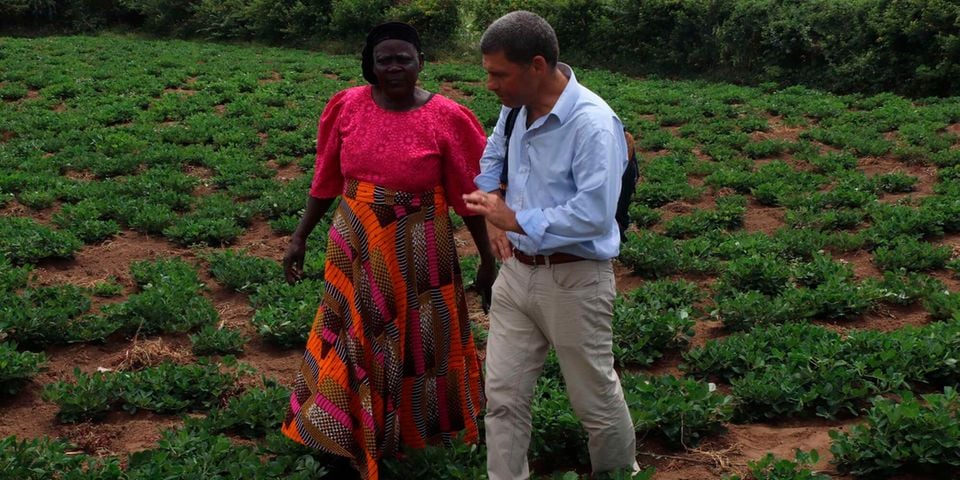
A dusty path off the Katito-Homa Bay road just before Miriu bridge leads the Seeds of Gold to groundnut farms in Koguta village, Kisumu County.
At this time two years ago, most plants would be withered. Inspecting or carrying out farm practices like weeding and spraying was also difficult as the plants were poorly spaced.
Group chairman Samuel Onyango says broadcasting was the preferred planting method.
“It led to low yields as plants competed for nutrients in a limited space. They dried when rains failed,” he says.
Weeds also competed for nutrients, with the peanut yields being of low quality. Some nuts were affected by aflatoxin.
Onyango says some locals abandoned groundnuts and went back to growing maize and sorghum.
However, a study by researchers from Sierra Leone, Burkina Faso, Ghana, Kenya, Tanzania and Ethiopia through a programme called East and West Africa Belt of Agricultural Intensification (EWABAI) showed that the farmers were doing everything wrong.
Three sacks
West Nyakach Ward Groundnut Farmers group used a seed variety that was not adapted to the local climate. Their planting method was outdated.
Later, the farmers started implementing what the researchers advised. They now use improved seed varieties and the planting method has changed.
Rose Olith, 45, has half an acre of groundnuts. She ensures the nuts are planted in rows and their spacing is given priority.
Ms Olith also ensures her seeds can withstand drought, pests and diseases.
“I expect to harvest three sacks of 40 kilos each,” she says, adding that a sack can sell for Sh3,200 to Sh3,600 locally.
“The broadcast groundnut plants acted as a cover crop for maize but the yield was negligible,” Ms Olith says.
Across River Miriu in Kowuor village are other farmers.
Like many others, Ms Jessica Osano has discovered the benefits of seeds that are adapted to the local climate and embracing new practices.
From her one acre piece, Ms Osalo expects a yield of eight sacks.
Groundnuts take three to four months to mature and can still do well in poor soils.
For farmers in Nyakach and Karachuonyo, the short maturity period means they can plant many types of crops in the same piece of land in one year. Unfortunately, that deprives the crops of essential nutrients as the soil gets exhausted.
EWABAI Project Coordinator Giovanna Seddain, a professor at the University of Sassari in Italy, says peanuts are of economic and nutritional value but are neglected by many farmers because of tropical diseases and pests.
“The researchers came together to make groundnut production one of the key activities in Nyakach and Karachuonyo,” Prof Seddain says.
Part of the research identified varieties that can do well in different areas. These are Nsinjiro, CG7,2991, CH9 and local.
Two varieties, including Nsinjiro from Malawi, were identified by farmers and processors as ideal.
Field day
Since farmers like Olith and Osano switched to the new seeds, their yields have improved by more than 90 per cent.
The two varieties adapt to the changing climate patterns and are resistant to pests and diseases.
Prof Seddain led other researchers during a field day in the two locations to learn about the success of the two varieties.
“We want to bridge the gap between potential and actual production,” she says.
Prof Sheila Okoth of the University of Nairobi and Dr Francis Waywa from the Kenya Agriculture Livestock Research Organisation (Kalro) are also involved in the study. They give farmers technical advice.
“Spacing should be slightly below or above 40 centimetres. What is happening is easy but has a huge impact,” Prof Seddain said.